
最近看到一个很有意思的开源硬件项目:Modos Flow。一句话概括,它是一台 13.3 英寸 USB-C 触控电子墨水屏显示器,显示驱动核心不是普通显示控制芯片,而是一颗 FPGA芯片。

项目地址:
https://github.com/Modos-Labs
众筹地址:
https://www.crowdsupply.com/modos-tech/modos-flow
上述页面有大量的演示视频。
大家对 E Ink 的第一印象通常是:省电、护眼、适合阅读,但刷新慢,刷新快了存在拖影,基本别想着当普通显示器用。
Modos Flow 做的事情就比较硬核:它把电子墨水屏的刷新控制交给 FPGA,通过自研的 Caster 控制逻辑,尽量只刷新变化区域,比如鼠标、光标、正在输入的文字,而不是每次都整屏刷一遍,这点比较有意思。
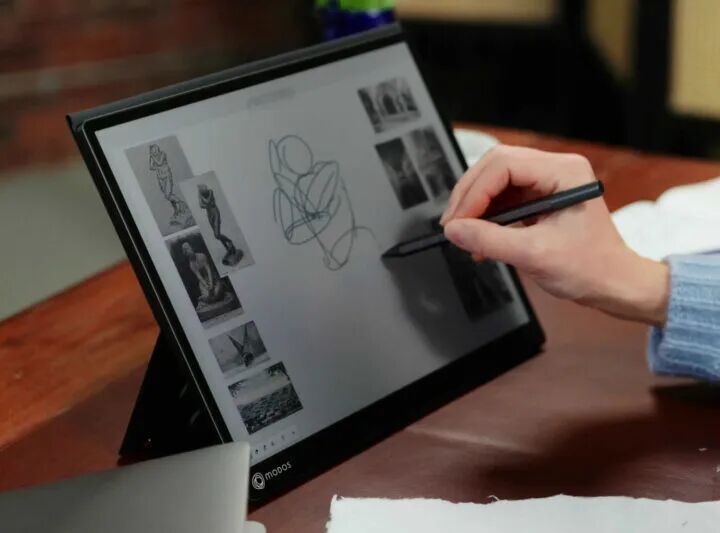
硬件配置
Modos Flow 的核心硬件大概是这样:
-
13.3 英寸 E Ink 屏幕
-
分辨率 3200 x 2400,约 300 PPI
-
USB-C DisplayPort Alt Mode 输入
-
单 USB-C 可跑到 40 Hz
-
额外供电时最高 60 Hz
-
支持触控
-
黑白版与彩色版可选
-
彩色版支持 4096 色、16 级灰阶、前光和手写笔
-
FPGA 使用 AMD Xilinx Spartan-6 LX16 FPGA,运行与前代开发套件一致的 Caster gateware
-
MCU 使用 STM32H750,负责 USB 通信、固件升级等工作
这里最值得看的不是“电子墨水屏显示器”这个概念,而是它背后的嵌入式架构。
传统电子墨水屏刷新慢,本质上和屏幕驱动波形、灰阶转换、整屏刷新机制都有关系。Modos 的 Glider/Caster 思路是把每个像素都尽可能当成独立更新单元处理,再配合早取消、区域更新、灰阶/二值混合等策略,让屏幕在交互时先快起来,静止后再慢慢补画质。
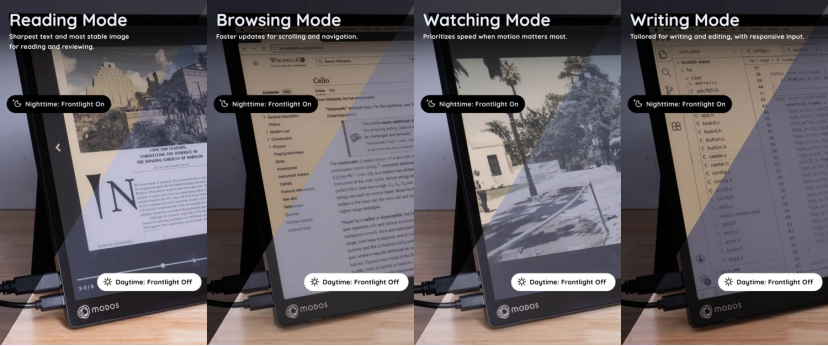
这就不是简单 SPI 屏幕刷图了,而是完整的显示控制器问题。
开源部分很香
GitHub 上的 Modos-Labs/Glider 仓库包含 PCB、固件、结构件等内容,README 里还写了大量 E Ink 驱动原理,包括波形、灰阶、抖动、低延迟驱动等。
官方也说明,FPGA gateware 使用 Caster,硬件设计基于 KiCad,MCU 固件可通过 STM32 工具链构建。
对工程师或者爱好者来说,这类项目比单纯看产品参数有意思得多。因为它把几个常见但不容易串起来的方向都放到了一起:
-
USB-C DP Alt Mode 视频输入
-
FPGA 显示驱动
-
DDR 帧缓存
-
STM32H7 固件
-
E Ink 波形与灰阶驱动
-
开源硬件生产与众筹交付
如果你做过普通 LCD、OLED 或 SPI 小屏,再看这个项目,会明显感受到电子墨水屏不是“换个屏幕接口”那么简单。
也别神化
当然,60 Hz 电子墨水屏不等于 LCD。电子墨水屏仍然会有残影、灰阶速度限制、颜色表现弱、价格高等问题。Modos Flow 黑白版众筹价为 619 美元,彩色版 719 美元,已经不是随便买来玩的价位。
但它的价值在于:这不是一个封闭的“护眼显示器”,而是一个能被研究、能被改、能被学习的开放硬件项目。
如果你对 FPGA、显示控制、低功耗设备或者 E Ink 生态感兴趣,这个项目很值得翻一翻。尤其是 Glider 仓库的 README,基本相当于一篇电纸屏控制器小教材。
Modos Flow 最酷的地方,不是它把电子墨水屏做成了显示器,而是它把“电子墨水屏为什么慢、怎么让它快一点”这个问题,用开源硬件方式摊开给大家看。
I recently came across a very interesting open-source hardware project: Modos Flow. To summarize in one sentence, it is a 13.3-inch USB-C touch e-ink display monitor with a display drive core that is not a typical display control chip, but an FPGA (Field-Programmable Gate Array) chip.
Project Address:
https://github.com/Modos-Labs
Crowdfunding Address:
https://www.crowdsupply.com/modos-tech/modos-flow
The above pages contain numerous demo videos.
The first impression most people have of E-ink is usually: energy-efficient, eye-friendly, suitable for reading, but with slow refresh rates and significant ghosting if forced to refresh quickly; essentially, it's not suitable for use as a standard display monitor.
What Modos Flow does is quite hardcore; it delegates the control of the e-ink screen refresh to the FPGA. Using its self-developed Caster control logic, it attempts to refresh only the changed regions (such as the mouse, cursor, and currently entered text) rather than performing a full-screen refresh every time. This is the most intriguing aspect.
Hardware Configuration
The core hardware of Modos Flow is roughly as follows:
13.3-inch E-ink screen
Resolution: 3200 x 2400, approximately 300 PPI
Input: USB-C DisplayPort Alternative Mode
Refresh Rate: Single USB-C supports up to 40 Hz, up to 60 Hz with additional power supply
Supports touch
Available in black-and-white and color versions
The color version supports 4096 colors, 16 levels of grayscale, front lighting, and a stylus.
FPGA: Uses the AMD Xilinx Spartan-6 LX16 FPGA, running the same Caster gateware as the previous development kit
MCU: Uses the STM32H750 to handle USB communication, firmware upgrades, and other tasks
What's worth noting here is not the concept of the "e-ink display monitor" per se, but the underlying embedded architecture.
The slowness of traditional e-ink screens is fundamentally due to the drive waveform, grayscale conversion, and the mechanism of full-screen refresh. Modos' Glider/Caster approach treats each pixel as an independent update unit as much as possible, and combines strategies such as early cancellation, regional updates, and mixed grayscale/binary rendering. This allows the screen to be fast during interaction and then gradually improve quality when static.
The Open-Source Component is Excellent
The Modos-Labs/Glider repository on GitHub contains PCB layouts, firmware, and mechanical components. The README file provides a wealth of information on e-ink drive principles, including waveforms, grayscale, dithering, and low-latency driving.
The official documentation states that the FPGA gateware uses Caster, the hardware design was performed in KiCad, and the MCU firmware can be built using the STM32 toolchain.
For engineers or hobbyists, this type of project is far more interesting than simply looking at product specifications. It combines several common but difficult-to-integrate fields:
USB-C DP Alternative Mode video input
FPGA display driving
DDR frame buffering
STM32H7 firmware
E-ink waveform and grayscale driving
Open-source hardware production and crowdfunding delivery
If you have experience with standard LCDs, OLEDs, or small SPI screens, looking at this project reveals that e-ink technology is not merely "swapping out the screen interface."
However, it should not be overly idealized.
A 60 Hz e-ink screen is not equivalent to an LCD. E-ink screens still suffer from significant drawbacks, including ghosting, limited grayscale speed, poor color representation, and high prices. The crowdfunding price for the Modos Flow black-and-white version is $619, and the color version is $719, which is beyond the range of a casual purchase.
Nevertheless, its value lies in the fact that it is not a closed "eye-friendly display," but a device that is open to study, modification, and learning.
If you are interested in FPGAs, display control, low-power devices, or the e-ink ecosystem, this project is definitely worth exploring. The README for the Glider repository essentially serves as a mini-tutorial on e-paper controllers.
The coolest feature of Modos Flow is not that it turned an e-ink screen into a display, but that it uses open-source hardware to clearly explain the problem of "why e-ink is slow and how to make it faster."
The coolest thing about Modos Flow is not that it turned an e-ink screen into a display, but that it lays out the problem of "why e-ink screens are slow and how to make them faster" in an open-source hardware way for everyone to see.
原文链接: https://mp.weixin.qq.com/s/xZFt0EPV7nalYPA2jMqr1A