
AR眼镜的核心体验之一为虚拟成像效果,需要通过光机与光学显示模组的设计呈现出效果清晰明亮的虚拟图像。然而,在室外强烈且复杂的光线条件下,AR眼镜的成像会被严重干扰,由于光机亮度限制及光线显示模组的光效限制,在强光环境下无法呈现如室内光线下清晰明亮的AR图像。
变色镜片可根据环境光线或电信号调节透光率,主要方案有光致变色与电致变色两类。电致变色(EC)技术通过将电致变色材料应用于显示模组镜片上,控制电致变色材料在不同电场作用下呈现不同的透光率,并且可在不同透过率之间快速切换,以应对外界环境的光线变化。相较于光致变色,电致变色响应速度更快、可控性更强,更适配AR眼镜的动态使用场景。

具有自动电致变色功能的XREAL 1S,图源:XREAL官网
1 电致变色原理
电致变色的变色原理主要有两种:(1)基于有机分子的氧化还原机理:在外电压的作用下,有机高分子或者小分子电致变色材料发生氧化还原反应,使其分子的能带发生变化,从而引起材料的颜色变化。(2)基于无机材料的晶格改变机理:外电压作用下,电解质离子嵌入到电致变色层引起晶格结构发生变化,从而使材料的颜色发生变化。电致变色器件的结构主要包括基底层、集流体层、电致变色层、电解质层以及离子存储层。
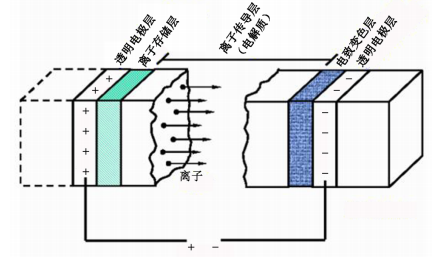
电致变色器件的典型结构
2 电致变色材料分类
电致变色材料按照化学性质的不同通常可分为无机电致变色材料、有机电致变色材料和复合电致变色材料。
无机电致变色材料
无机电致变色材料主要是由过渡金属氧化物和普鲁士蓝组成。过渡金属氧化物按照材料着色态发生电化学反应原理的不同,又可分为阳极着色氧化物和阴极着色氧化物。具有代表性的阳极电致变色材料有NiO和Co3O4。具有代表性的阴极电致变色材料有WO3和TiO2。此外V2O5在具有阳极电致变色性能的同时兼具阴极电致变色性能,被认为是中性电致变色氧化物。
有机电致变色材料
有机电致变色材料按照致色原理分为导电聚合物、金属有机络合物和氧化还原型化合物。
导电聚合物属于有机高分子聚合物,其结构特点是均存在共轭π电子结构,因为电荷的注入而使π电子具有较大的共轭离域体系,代表物主要有聚苯胺、聚吡咯、聚噻吩、聚呋喃等。
金属有机络合物电致变色材料也称金属有机螯合物,其中提供d空轨道的金属离子为过渡元素,而提供孤电子对的配位体为有机分子。
紫罗精是典型的氧化还原型有机电致变色材料,其结构特点是存在共轭π键体系和杂原子(电子给予原子,如N、O、S等)以及π键掺杂原子。
有机/无机复合电致变色材料
无机电致变色材料化学稳定性良好、合成方法较为成熟,但存在颜色变化单一、响应速度慢和着色效率低等问题。有机电致变色材料虽然颜色变化多样、响应速度快、成本较低,但与衬底附着力差、循环寿命较短。将有机电致变色材料与无机电致变色材料复合,构成无机/有机复合电致变色材料,该复合材料通常具有独特显微结构和表观协同效应。目前将有机电致变色材料与纳米结构的无机材料进行复合,已经成为研究的热点。
3 电致变色工艺
无机电致变色依赖磁控溅射镀膜工艺。超白玻璃基板经清洗后,在真空设备中依次溅射沉积5层功能膜:底层ITO、离子存储层、电解质层、电致变色层及顶层ITO。镀膜后需退火提升材料致密性,最后与第二层玻璃通过PVB夹层在高压釜中复合。此工艺仅适用于平面玻璃,曲面镀膜厚度偏差>15%,且响应速度随面积增大而显著下降(约5min/m2),大多应用于大面积建筑幕墙。
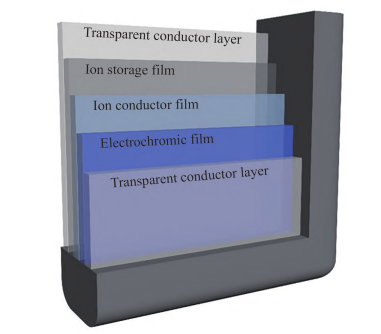
无机EC产品制造流程
有机EC采用卷对卷涂布柔性工艺,以PET-ITO薄膜为基底,经等离子清洗后,通过狭缝涂布依次涂布电致变色层、全固态凝胶电解质及离子存储层。涂布后经分段烘箱干燥与紫外固化交联,最后与钢化玻璃通过PVB胶膜热压复合。有机EC材料可兼容刚性和柔性基底,且响应速度比无机EC快,可应用于消费电子及使用曲面玻璃的交通领域。
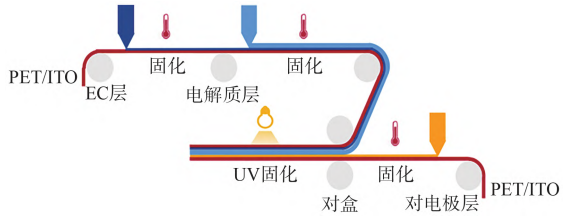
有机EC产品制造流程
4 电致变色在AR眼镜中的应用及代表企业
电致变色材料在AR眼镜上有两种应用方式:一种是在玻璃基材镀膜,属于前装,需要在AR眼镜的设计环节介入,这种方式可以有效地与波导片进行结合,做到不增加重量和厚度地完成变色功能集成;另一种是柔性贴膜,可以通过后装的方式外挂在已有的AR眼镜产品上。两种皆适用于阵列、衍射、全息等波导方案的眼镜产品。
提供电致变色材料/技术的企业主要有伯宇科技、华瓴光学、光羿科技、览锐光电等。
苏州伯宇科技有限公司
伯宇科技成立于2019年,是一家集研发、生产、销售、代加工、售后为一体的高科技企业,致力于下一代数控变色技术与产品的开发与应用。伯宇科技基于无机全固态数控变色材料开发的“数控电致变色镜片”可以为AR产品提供更自然、更沉浸的体验,被广泛应用于三星电子、小米等全球顶尖厂商的智能眼镜,它能够极大地提升AR设备的成像质量和用户体验,已经成为AR行业的核心合作伙伴。
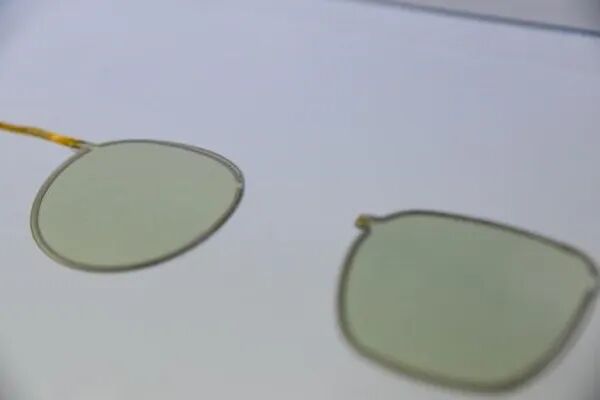
数控电致变色镜片,图源:伯宇科技
宁波华瓴光学技术有限公司
华瓴光学成立于2021年,是一家全球领先的电致变色系统器件的方案提供商。华瓴光学核心团队拥有多年电致变色产品全套核心专利技术和持续更新迭代的雄厚技术和制造能力,通过整合光学技术、半导体封装技术、消费电子上下游产业链资源,已形成在消费电子、车载、安防及光学成像产品领域强大的市场竞争力。公司研发的柔性凝胶态电致变色技术,不仅能变色,还具有任意曲度、透光率高、多尺寸等特点,极大地拓宽了应用领域,尤其是在AR领域中极具意义。
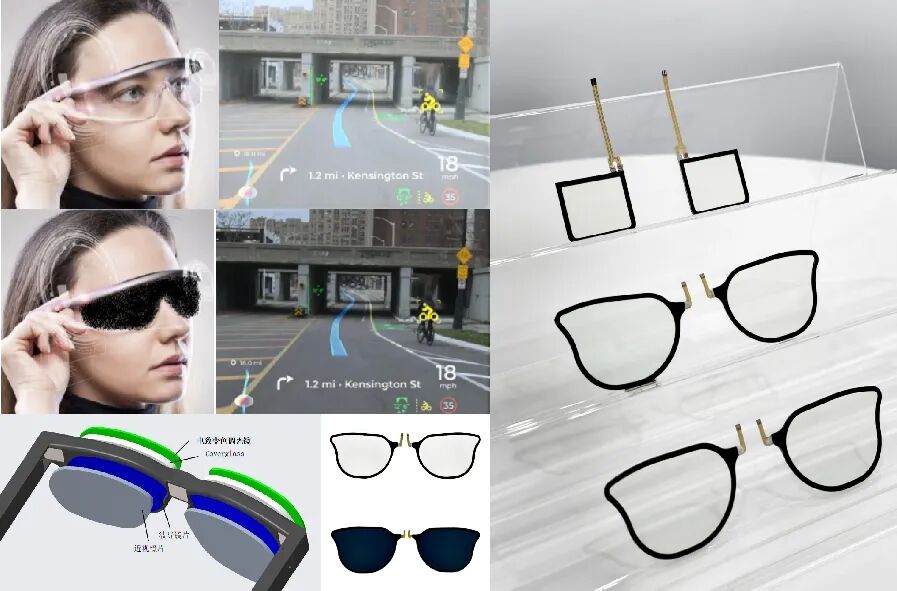
图源:华瓴光学
深圳市光羿科技有限公司
光羿科技成立于2017年,总部位于深圳,是一家在全球电致变色技术领域具有重要影响力的创新型科技公司。光羿科技致力于第三代EC技术的开发和商业化,颠覆性采用卷对卷工艺,高效量产柔性薄膜基底产品,为汽车、建筑、消费电子等更多领域提供产品和解决方案。

图源:光羿科技公众号
览锐光电(杭州)有限公司
览锐光电于2015年7月在美国科技中心硅谷成立,是全球最早探索柔性大面积电致调光薄膜技术的企业之一。公司专注于电致变色核心技术研发与产业化落地,致力于开发最新一代全柔性卷对卷高速涂布的高分子调光薄膜,通过极致的全固体材料系统及高效率生产制程,推动电化学变色调光技术的广泛应用及大面积安装。公司持续深耕消费电子领域,进一步拓展电致变色技术在AI/AR眼镜等应用范围,推动新一代技术产品快速迭代。
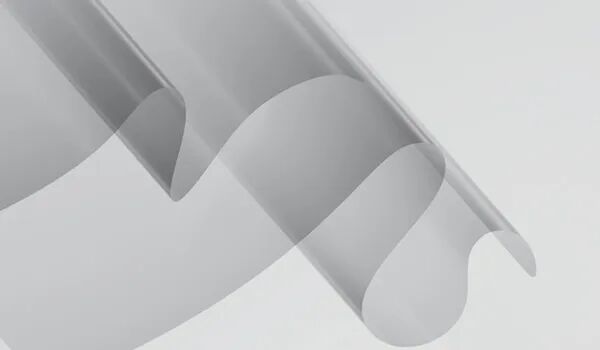
薄膜产品,图源:览锐光电
参考来源:
[1]赵海燕等:智能调光技术研究进展及产业化情况分析
[2]冉东生:电致变色智能材料的应用与发展
[3]庄碧莹等:电致变色材料的研究与应用进展
[4]小米技术、维深 Wellsenn XR、公司官网
注:图片非商业用途,存在侵权告知删除!
One of the core experiences of AR glasses is the virtual imaging effect, which requires the design of optical machines and optical display modules to present clear and bright virtual images. However, under strong and complex outdoor light conditions, the imaging of AR glasses is severely interfered with. Due to the limited brightness of optical machines and the optical efficiency limits of light display modules, clear and bright AR images cannot be presented in strong light environments as they can in indoor light.
Photochromic lenses can adjust their light transmittance based on environmental light or electrical signals. The main schemes include photochromism and electrochromism. Electrochromic (EC) technology applies electrochromic materials to the display module lenses, controlling the material to exhibit different transmittances under different electric field strengths. It can quickly switch between different transmittance levels to cope with changes in the external light environment. Compared to photochromism, electrochromism has faster response speeds and stronger controllability, making it more suitable for the dynamic usage scenarios of AR glasses.
XREAL 1S with automatic electrochromic function. Image source: XREAL official website.
1 Electrochromic Principle
The color-changing principle of electrochromism primarily consists of two mechanisms: (1) Redox mechanism based on organic molecules: Under an external voltage, organic high-molecular or small-molecule electrochromic materials undergo oxidation-reduction reactions, causing a shift in the molecule's energy band and resulting in a color change. (2) Lattice change mechanism based on inorganic materials: External voltage causes electrolyte ions to embed into the electrochromic layer, changing the crystal lattice structure and consequently the material's color. The structure of an electrochromic device typically includes a substrate layer, a current collector layer, an electrochromic layer, an electrolyte layer, and an ion storage layer.
Typical structure of an electrochromic device.
2 Classification of Electrochromic Materials
Electrochromic materials are generally classified into inorganic, organic, and composite classes based on their chemical properties.
Inorganic Electrochromic Materials
Inorganic electrochromic materials are mainly composed of transition metal oxides and Prussian blue. Transition metal oxides are further classified into anodic coloring oxides and cathodic coloring oxides based on the electrochemical reaction mechanism of their colored states. Representative anodic electrochromic materials include NiO and Co3O4. Representative cathodic electrochromic materials include WO3 and TiO2. Additionally, V2O5 exhibits both anodic and cathodic electrochromic properties, making it a neutral electrochromic oxide.
Organic Electrochromic Materials
Organic electrochromic materials are classified into conductive polymers, metal-organic complexes, and redox compounds based on their coloring principles.
Conductive polymers are organic high-molecular polymers characterized by conjugated π-electron structures. They exhibit large conjugated delocalized systems upon charge injection. Representatives include polyaniline, polypyrrole, polythiophene, and polyfuran.
Metal-organic complex electrochromic materials, also known as metal-organic chelates, feature a transition metal ion providing d-orbitals coordinated with an organic molecule providing a lone electron pair.
Spiropyran is a typical redox-active organic electrochromic material, characterized by a conjugated π-bond system and the presence of heteroatoms (electron donor atoms like N, O, S) or π-bond doping atoms.
Organic/Inorganic Composite Electrochromic Materials
Inorganic electrochromic materials have good chemical stability and mature synthesis methods but suffer from limited color variation, slow response speed, and low coloring efficiency. While organic electrochromic materials offer diverse colors, fast response, and low cost, they often have poor adhesion to substrates and short cycle lifetimes. Composite materials that combine organic and inorganic electrochromic components often exhibit unique microstructures and synergistic effects. Currently, combining organic electrochromic materials with nanostructured inorganic materials is a popular research area.
3 Electrochromic Manufacturing Processes
Inorganic electrochromic devices rely on magnetron sputtering for film deposition. A cleaned ultra-white glass substrate is placed in a vacuum chamber where five functional layers are sequentially sputtered: a bottom ITO layer, an ion storage layer, an electrolyte layer, an electrochromic layer, and a top ITO layer. The film is then annealed to improve material density and finally laminated with a second glass layer using a PVB interlayer in a high-pressure autoclave. This process is limited to flat glass, with significant thickness deviations (>15%) on curved surfaces and a response speed that decreases with increasing area (~5 minutes/m²), making it predominantly suitable for architectural curtain walls.
Manufacturing process for inorganic EC products.
Organic EC devices use a roll-to-roll coating process for flexible substrates. A PET-ITO film is plasma-cleaned and then coated via slot-die with an electrochromic layer, a solid-state gel electrolyte, and an ion storage layer. The film is dried in a segmented oven, UV-cured, and finally laminated to a tempered glass substrate with a PVB adhesive. This process supports both rigid and flexible substrates, offers faster response times than inorganic EC, and is applicable to consumer electronics and transportation fields using curved glass.
Manufacturing process for organic EC products.
4 Application of Electrochromism in AR Glasses and Representative Companies
Electrochromic materials are applied in two ways on AR glasses: as a coating on the glass lens (front-loaded) or as a flexible film adhered to the device (rear-loaded). The former is integrated during the design phase and allows for a seamless combination with the waveguide without adding weight or thickness. The latter offers a modular upgrade option for existing models. Both methods are compatible with various waveguide types, including array, diffraction, and holographic waveguides.
Leading providers of electrochromic materials and technology include Boyu Technology, Hualing Optics, Guangyi Technology, and Lanrui Optoelectronics.
Suzhou Boyu Technology Co., Ltd.
Established in 2019, Boyu Technology is a high-tech enterprise specializing in the research, production, sales, and after-sales of next-generation controlled color-changing products. Their "Digital-controlled Electrochromic Lenses," based on inorganic all-solid-state materials, provide a more natural and immersive experience for AR products. Partnering with global leaders like Samsung and Xiaomi, they have become a key player in the AR industry by significantly improving image quality and user experience.
Digital-controlled Electrochromic Lenses. Image source: Boyu Technology.
Ningbo Hualing Optics Technology Co., Ltd.
Founded in 2021, Hualing Optics is a leading provider of electrochromic system devices. With a team possessing extensive patents and manufacturing expertise in EC technology, Hualing integrates optics, semiconductor packaging, and consumer electronics supply chains. Their flexible gel-state electrochromic technology, characterized by its malleability, high transmittance, and multi-size capability, has significantly expanded application possibilities, particularly in the AR sector.
Image source: Hualing Optics.
Shenzhen Guangyi Technology Co., Ltd.
Founded in 2017 in Shenzhen, Guangyi Technology is a pioneering force in the global electrochromic field. They focus on commercializing third-generation EC technology, utilizing roll-to-roll processes to efficiently produce flexible film products. Their solutions cater to a wide range of industries, including automotive, architecture, and consumer electronics.
Image source: Guangyi Technology WeChat account.
Lanrui Optoelectronics (Hangzhou) Co., Ltd.
Established in Silicon Valley in 2015, Lanrui Optoelectronics was an early pioneer in large-area flexible electrochromic film technology. The company specializes in the research and industrialization of core EC technologies, focusing on high-throughput roll-to-roll coating of polymer dimming films. Their advancements in solid-state materials and efficient manufacturing have driven widespread adoption of EC technology, particularly in consumer electronics like AI/AR glasses.
Film products. Image source: Lanrui Optoelectronics.
References:
[1] Zhao Haiyan et al.: Research Progress and Industrialization Status of Smart Dimming Technology.
[2] Ran Dongsheng: Application and Development of Electrochromic Smart Materials.
[3] Zhuang Biying et al.: Research and Application Progress of Electrochromic Materials.
[4] Xiaomi Technology, Wellsenn XR, Company websites.
注:图片非商业用途,存在侵权告知删除!